
We Built This Because the System Wasn't Built for You
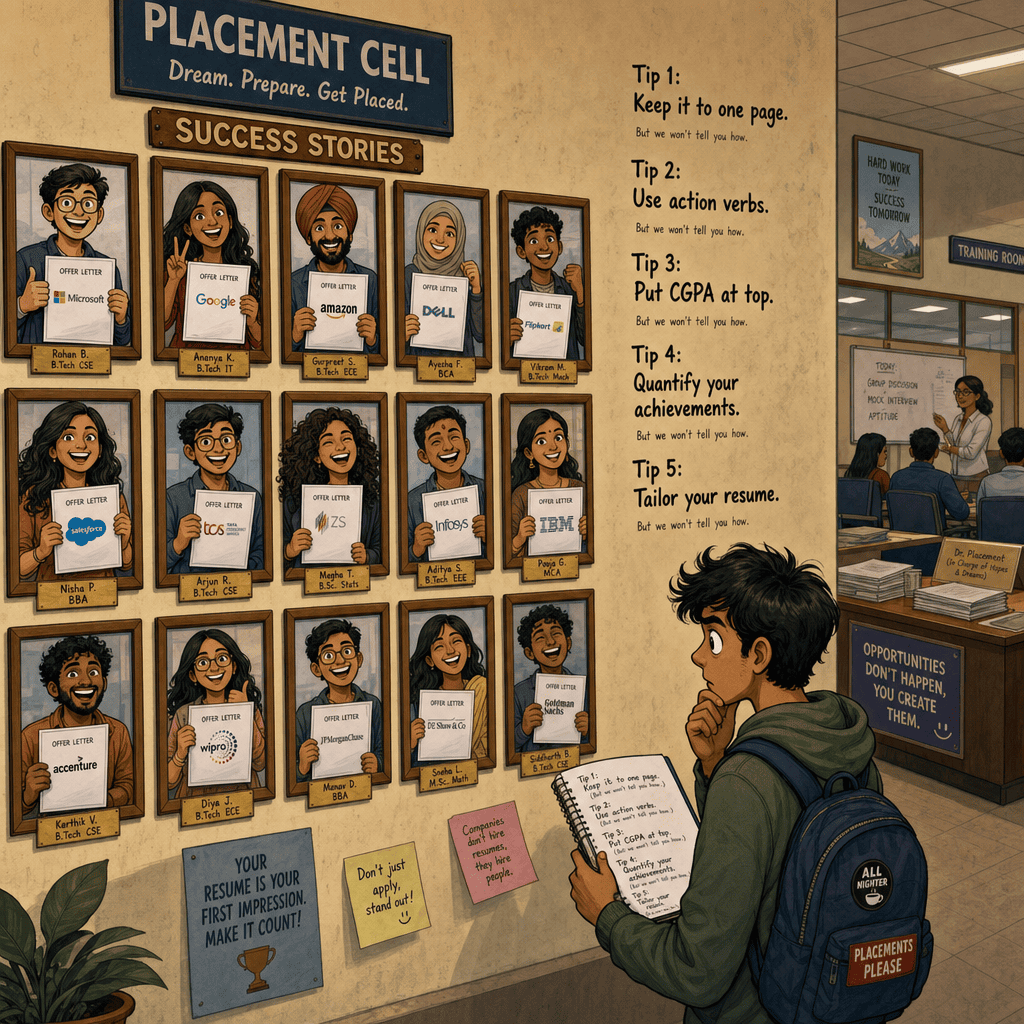
Simhaant exists for the student the system kept filtering — and never prepared.
You didn't arrive at final year by accident. You got here through a decade of pressure that started before you were old enough to choose it.
10th boards. Entrance exams. 12th boards. Another round of entrance exams. Four years of balancing attendance, backlogs, internships that were hard to get, coaching classes you attended because the curriculum alone wasn't enough — and family expectations that never paused to ask how you were holding up.
You did all of that. And now, in your final year, the system hands you a Word document and calls it a resume.
The TPO Did What They Could. It Wasn't Enough.
We are not here to blame placement cells. Some TPO officers are genuinely trying to help hundreds of students with almost no resources, in a job market that is stagnant or shrinking. Their hands are tied by college politics, company footfall that never comes, and placement records they are pressured to protect — even if it means asking struggling students to quietly withdraw their names.
The result is the same either way. You get a generic resume format, a shortlisting stamp, and silence from the other side.
That silence is not your verdict. It is a system gap. And it is exactly what Simhaant was built to close.
The Job Market Made It Harder. We're Not Going to Pretend Otherwise.
AI has already displaced a significant number of junior and mid-level roles that freshers used to enter through. Experienced professionals are being laid off. Companies that used to hire at scale are now automating entry-level work with agentic AI systems. On-campus recruitment at Tier 2 and Tier 3 colleges — already thin — has become thinner.
We know this. We are not going to tell you that a better resume fixes all of it. It doesn't.
What we will tell you is this: in a market where every advantage matters, the one document that reaches a recruiter before you do must work as hard as possible. Your resume is not the whole battle. But it is the first gate. And right now, for most students, it is closing that gate before they even know it.
What Simhaant Actually Is
Simhaant is India's first career readiness intelligence service for final-year students. Not a template. Not a review. Not a checklist.
A complete, honest evaluation of where you actually stand — your profile, your story, your strengths, your gaps, and your realistic competitive position in the market you are about to enter.
We start with 31 questions that nobody has ever asked you. Questions about what you actually want, what you have quietly achieved that never made it onto your resume, and what genuinely worries you about what comes next. Your answers shape an evaluation that is specific to you — not a generic read of "an engineering student's resume."
You receive three reports. A Personal Report written directly to you in plain language. A Scorecard that breaks down every dimension of your profile analytically. And a Direction and Priority Card that tells you exactly what to do in the next 30 days.
That is your CPI Report. Your Career Profile Intelligence.
We Are On Your Side. Completely.
Simhaant was founded by someone who navigated this system over three decades ago — when the struggles were different but the pressure was just as real. The specifics have changed. The weight on the student has only grown.
We built this because the information that could genuinely help a final-year student — honest competitive positioning, a real read of their profile, a clear action plan — has always been available. Just not to them. It existed behind the doors of expensive coaching, elite networks, and families who knew how the system worked.
That changes now.
Simhaant is for every serious final-year student in India. Engineering, medicine, commerce, science, arts. Tier 1, Tier 2, Tier 3. Whether your college sends fifty students to TCS every year or struggles to get one company on campus.